
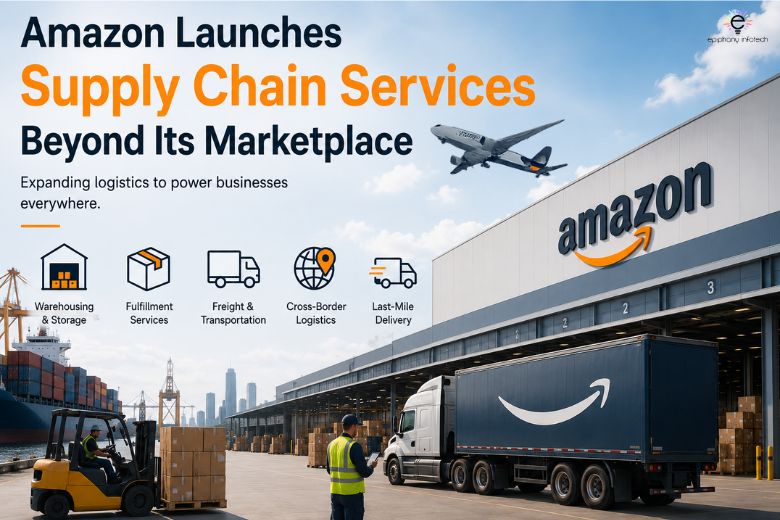
Amazon has expanded its logistics operations by launching Amazon Supply Chain Services (ASCS), which are now available to businesses beyond its marketplace ecosystem. The move shifts Amazon from a marketplace-focused fulfilment provider to a broader logistics service operator.
This development introduces access to Amazon’s fulfillment network, transportation systems, and delivery infrastructure for a wider range of businesses, including those that do not sell on Amazon.
Amazon Supply Chain Services Launch: What Was Announced?
Amazon has launched a major expansion of its logistics ecosystem, introducing Amazon supply chain services designed to extend beyond its own marketplace sellers. The move marks a shift in how Amazon positions its Amazon logistics services, opening its infrastructure to a wider range of businesses, including those that do not sell directly on Amazon.
According to reporting from CNBC and TechCrunch, the announcement was made in early May 2026, positioning Amazon more directly in the global ecommerce logistics and third-party logistics space.
When Did Amazon Launch Its Supply Chain Services?
Amazon’s expanded supply chain offering was publicly reported in early May 2026, with multiple outlets confirming the rollout timeframe between May 4 and May 6, 2026. The launch aligns with Amazon’s broader strategy of monetising its logistics infrastructure beyond internal marketplace use.
Sources indicate that this is not a completely new system but an expansion of existing infrastructure under a more unified Amazon supply chain services framework.
What Are Amazon Supply Chain Services and What Do They Include?
Amazon Supply Chain Services is a unified logistics offering that integrates storage, transportation, fulfillment, and delivery into a single end-to-end network. It extends Amazon’s fulfillment infrastructure beyond marketplace sellers and makes it accessible to external businesses as a broader logistics solution.
According to Amazon’s official supply chain overview, the service is designed to support businesses with scalable logistics capabilities through a single integrated system.
The structure of Amazon Supply Chain Services is built around multiple connected logistics components that work together across the fulfilment ecosystem.
Core Components of Amazon’s Supply Chain Network
Amazon Supply Chain Services operates through a full-stack logistics model that combines several core functions:
- Amazon fulfillment services
- Amazon logistics services
- Multi-channel fulfillment
- Cross-border logistics
- Freight and transportation services
This integration allows inventory movement, order processing, and delivery to function within a single coordinated system rather than separate logistics stages.
Freight and Transportation Services
Amazon now offers inbound freight solutions, including ocean, air, and trucking coordination. This strengthens its freight transportation capabilities by integrating upstream supply movement directly into its system.
Warehousing and Storage Infrastructure
Businesses can access Amazon’s global fulfilment centres for storage and inventory management. This expands Amazon’s warehousing infrastructure into a service-based model rather than being limited to marketplace sellers.
Multi-Channel Fulfilment and Cross-Border Logistics Explained
One of the most significant changes is multi-channel fulfillment, where businesses can store products in Amazon warehouses and ship orders from external platforms such as Shopify or independent ecommerce websites.
Last Mile Delivery Services
Amazon’s delivery network handles final-mile logistics, leveraging its existing delivery fleet and partner network to complete shipments.
Cross-Border Logistics Support
The system supports international shipping, customs handling, and global distribution, strengthening Amazon’s position in cross-border logistics.
Who Can Use Amazon Supply Chain Services?
Based on early rollout information, the service is primarily being introduced in the United States, with expansion planned across key international logistics corridors.
Amazon has indicated that availability will scale in phases, leveraging its existing global fulfilment infrastructure.
Who Is Eligible to Use Amazon Supply Chain Services?
Eligibility is broad and includes:
- Amazon marketplace sellers
- Non-Amazon ecommerce businesses
- Enterprise brands and manufacturers
- Retail and wholesale distributors
This makes the platform distinct from traditional FBA, as it is not restricted to Amazon seller accounts alone.
Businesses working with Amazon e-commerce agencies or Amazon SEO services often integrate these solutions to support operational scaling and improve logistics efficiency. In such cases, specialised providers such as Epiphany Infotech help streamline implementation and enhance overall Amazon strategy execution.
Benefits for Non-Amazon Sellers and Ecommerce Businesses
Amazon’s expansion of Amazon supply chain services changes how non-marketplace businesses access logistics infrastructure. Instead of relying only on Amazon sellers’ ecosystem, external brands can now use Amazon as a full backend ecommerce logistics provider.
This means companies that do not sell on Amazon can still use its Amazon fulfillment services, warehousing, and delivery network to process and ship orders from their own sales channels.
According to Amazon’s supply chain platform overview, the system is designed to support both marketplace and external businesses through a unified logistics structure.
How Can Businesses Selling Outside Amazon Use These Services?
Businesses selling outside Amazon can integrate their online stores directly with Amazon’s logistics system. Once connected, inventory is stored in Amazon fulfilment centres, and orders placed on external websites are processed through Amazon’s network.
This model, commonly known as multi-channel fulfillment, allows Amazon to act purely as a logistics provider rather than a sales platform. It supports ecommerce stores built on platforms such as Shopify or independent websites, where Amazon handles picking, packing, and delivery in the background.
What Benefits Does Amazon Offer to Independent Ecommerce Brands?
For independent ecommerce brands, the primary advantage is access to Amazon’s large-scale logistics infrastructure without building their own systems.
Amazon’s fulfillment network provides faster shipping times, particularly through its established last-mile delivery system. Businesses also gain access to cross-border shipping capabilities, which strengthen international reach without requiring separate logistics partners in each region.
This level of infrastructure is typically associated with large retailers, but Amazon is now extending it through its broader Amazon Logistics Services model.
How Does This Reduce Operational Complexity for External Sellers?
Traditionally, ecommerce businesses must coordinate multiple logistics providers for warehousing, shipping, and delivery. This creates complexity in tracking inventory, managing costs, and ensuring consistent delivery performance.
By consolidating these functions, Amazon reduces the need for separate systems. Inventory storage, order fulfilment, shipping, and tracking are all handled within a single ecosystem.
This integration is one of the key drivers behind the expansion of Amazon fulfillment services, particularly for businesses seeking scalability without building logistics infrastructure from scratch.
What Impact Could Faster Delivery Have on Conversion Rates?
Delivery speed has become a critical factor in ecommerce performance. Faster fulfillment often leads to higher customer satisfaction and improved purchase completion rates.
By using Amazon’s logistics network, businesses can offer shorter delivery times, which typically improves conversion rates and reduces cart abandonment. This is especially important in competitive online retail categories where delivery expectations are already high.
How Does Amazon Supply Chain Services Work Across the Logistics Network?
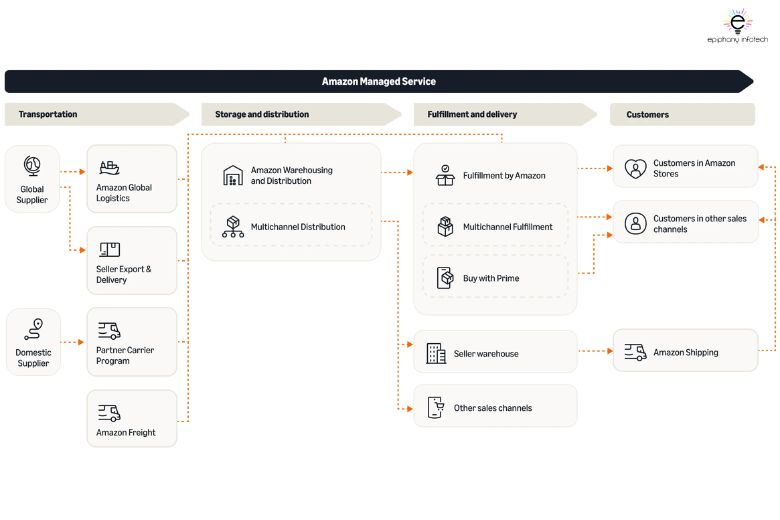
- Source: Amazon Supply Chain
Amazon’s supply chain services operate as an integrated logistics system that connects storage, transportation, fulfilment, and delivery into a single operational flow. Instead of functioning as separate services, Amazon links each stage of the supply chain through its Amazon Logistics Services infrastructure, allowing businesses to manage inventory and orders through one unified network.
This system is built on Amazon’s existing global fulfilment architecture and is now extended to both marketplace sellers and external businesses.
How Does Amazon Manage End-to-End Supply Chain Operations?
Amazon manages supply chain operations through a vertically integrated model that connects suppliers, warehouses, and delivery networks.
Products typically move through the following stages:
- Goods are received into Amazon fulfilment centres
- Inventory is stored and tracked in real time
- Orders are processed through automated systems
- Items are picked, packed, and dispatched
- Final delivery is completed through Amazon’s delivery network
This end-to-end structure is a key part of Amazon’s fulfillment services, where logistics is treated as a continuous flow rather than separate steps.
How Does Inventory Move Through Amazon’s Network?
Inventory movement within Amazon’s system is driven by demand forecasting and regional distribution planning. Products are stored across multiple fulfilment centres to reduce delivery time and optimise shipping routes.
When an order is placed, Amazon’s system automatically identifies the nearest available stock location and routes the shipment accordingly. This reduces transit time and improves efficiency within the fulfillment network.
The structure also supports reallocation of inventory between warehouses to balance demand across regions, particularly during peak ecommerce periods.
How Does Multi-Channel Fulfilment Support Non-Amazon Sales?
One of the key features of the expanded system is multi-channel fulfillment, which allows businesses to use Amazon’s logistics network even when sales occur outside Amazon.
In this model, businesses send inventory to Amazon warehouses, but orders are triggered from external platforms such as ecommerce websites or third-party marketplaces. Amazon then handles fulfillment and delivery without the order being processed through its own retail platform.
This capability extends Amazon fulfillment services beyond marketplace dependency and positions Amazon as a standalone logistics provider.
How Are Freight, Warehousing, and Delivery Integrated?
Amazon integrates freight, warehousing, and delivery through a single logistics framework supported by automation and data systems.
- Freight operations manage the inbound movement of goods from suppliers to warehouses.
- Warehousing systems store and organise inventory across fulfilment centres
- Delivery networks manage last-mile distribution to end customers
These components are connected through real-time inventory tracking and routing systems, which ensure that each order is processed through the most efficient logistics path.
This integration is a core part of Amazon’s broader ecommerce logistics strategy, combining infrastructure and technology into a unified supply chain model.
Pricing and Cost Structure of Amazon Supply Chain Services
Amazon structures its Amazon supply chain services on a flexible, usage-based pricing model designed to scale with business size and order volume. Instead of fixed contracts, costs are tied directly to logistics activities such as storage, fulfilment, and transportation.
The system reflects how Amazon operates its broader Amazon logistics services, where efficiency, automation, and scale influence pricing across the entire network.
While exact pricing varies by region and business type, the structure generally follows four main cost categories.
How Does Amazon Price Freight and Transportation Services?
Freight costs are based on the movement of goods into Amazon’s fulfilment centres. Pricing typically depends on shipment weight, distance, and transport method, including air, sea, or ground freight.
This segment is part of Amazon’s freight transportation system, which is integrated into its global supply chain network to optimize inbound logistics at scale.
What Are the Warehousing and Storage Charges?
Storage fees are applied for keeping inventory in Amazon’s fulfilment centres. These charges are generally calculated based on:
- Storage volume
- Duration of inventory held
- Seasonal demand periods
During peak ecommerce seasons, storage costs can increase due to higher demand for warehouse capacity within Amazon’s warehousing infrastructure.
How Does Fulfilment and Delivery Pricing Work?
Fulfilment pricing is applied per order and includes picking, packing, packaging, and shipping operations. These costs fall under Amazon fulfilment services, where each transaction is processed as a separate fulfilment event.
Delivery charges vary based on speed and destination, with faster shipping options typically priced higher due to priority routing within the logistics network.
Amazon Supply Chain Services Cost Structure Overview
The pricing model can be summarised as follows:
| Cost Component | What It Covers | Pricing Basis |
| Freight Transportation | Inbound movement of goods to fulfilment centres | Weight, distance, transport mode |
| Warehousing & Storage | Inventory storage inside Amazon facilities | Volume, duration, seasonal demand |
| Fulfilment Services | Picking, packing, and order processing | Per unit or per order |
| Delivery (Last Mile) | Final delivery to customer address | Speed, region, distance |
Are There Cost Advantages Compared to Third-Party Logistics Providers?
Amazon’s scale and automation allow it to offer competitive pricing compared to many third-party logistics providers. By combining storage, fulfilment, and delivery within a single ecosystem, businesses may reduce operational fragmentation and vendor dependency.
Key efficiency factors include:
- High-volume shipping discounts
- Optimised routing systems
- Integrated warehouse and delivery operations
- Reduced overhead from multiple logistics vendors
However, actual cost efficiency depends on product category, order volume, and storage duration. This makes ecommerce logistics costs highly variable across businesses.
Why Is Amazon Expanding Supply Chain Services Beyond Its Marketplace?
Amazon’s decision to expand its supply chain services beyond its marketplace reflects a shift from being primarily an ecommerce platform to becoming a global logistics infrastructure provider. The company is extending its Amazon logistics services to external businesses in order to scale its fulfillment ecosystem beyond internal sellers.
This expansion positions Amazon directly within the broader ecommerce logistics industry, where demand for integrated storage, fulfilment, and cross-border shipping continues to grow.
According to Amazon’s official announcement, the new supply chain services are designed to support both Amazon sellers and external enterprises through a unified logistics network.
How Large Is Amazon’s Logistics Infrastructure?
Amazon operates one of the most extensive logistics systems globally, built around a large network of fulfilment centres, transportation fleets, and automated warehouse systems.
Key components include:
- A distributed global fulfilment network
- High-capacity warehousing infrastructure
- Integrated freight and transportation systems
- Advanced last-mile delivery operations
This scale allows Amazon to process large order volumes efficiently and strengthens its position in Amazon fulfillment services, which now extends beyond marketplace operations into third-party logistics support.
Why Is Amazon Targeting Non-Marketplace Businesses?
A major driver behind this expansion is access to businesses that operate outside Amazon’s retail ecosystem. By opening its logistics network, Amazon can serve a much wider customer base, including direct-to-consumer brands, manufacturers, wholesalers, and international ecommerce companies.
This shift reduces dependence on marketplace transactions and expands Amazon’s role in global cross-border logistics and supply chain infrastructure.
It also reflects increasing demand from businesses seeking scalable logistics solutions without investing in their own warehouse and delivery networks.
How Does This Expansion Create New Revenue Streams?
By offering logistics services to external businesses, Amazon introduces additional revenue streams beyond retail sales and seller fees.
These include:
- Warehousing and storage fees
- Fulfilment and handling charges
- Freight and transportation services
- International shipping and logistics operations
This transforms Amazon fulfillment services into a standalone business model within Amazon’s broader ecosystem, similar in structure to third-party logistics providers but operating at a significantly larger scale.
As reported by CNBC, this strategy positions Amazon to compete more directly in the global logistics market while monetising its existing infrastructure more efficiently.
How Amazon’s Supply Chain Network Is Reshaping Global Logistics
Amazon’s expansion of Amazon supply chain services beyond its marketplace is reshaping competitive dynamics in the global logistics sector. By opening its infrastructure to external businesses, Amazon is no longer only an ecommerce platform operator but is increasingly positioned as a direct competitor in ecommerce logistics and third-party fulfilment markets.
This shift has implications for logistics providers, ecommerce brands, and supply chain pricing structures across multiple regions.
How Does This Affect Third-Party Logistics Providers?
Traditional third-party logistics providers (3PLs) face increased competitive pressure as Amazon expands its Amazon Logistics services offering.
Companies such as regional warehousing operators, freight brokers, and fulfilment specialists now compete with a vertically integrated system that combines:
- Warehousing infrastructure
- Freight transportation
- Last-mile delivery networks
- Integrated software systems
Because Amazon operates at a large scale, its ability to bundle Amazon fulfillment services can create pricing and efficiency pressure on independent logistics firms.
How Could Amazon Influence Logistics Pricing and Competition?
Amazon’s scale allows it to optimize logistics costs through automation, route efficiency, and high-volume operations. As more businesses adopt its supply chain services, pricing benchmarks across the industry may shift.
Key competitive effects include:
- Increased pricing pressure on standalone logistics providers
- Standardisation of fulfilment and delivery costs
- Greater reliance on integrated logistics platforms
- Potential consolidation in fragmented logistics markets
Industry analysis from Supply Chain Outlook highlights that Amazon’s model blends infrastructure ownership with service delivery, increasing its influence over global logistics pricing structures.
What Concerns Exist Around Data and Market Control?
A key concern among industry observers is Amazon’s access to logistics and sales data from external businesses using its system.
Because Amazon operates both infrastructure and platform layers, it gains visibility into:
- Inventory movement patterns
- Product demand trends
- Regional sales performance
- Fulfilment velocity data
This level of data access raises questions around competitive neutrality, especially when Amazon operates its own retail ecosystem alongside third-party logistics services.
How Might Competitors Respond to Amazon’s Expansion?
Competitors in the logistics sector may respond through:
- Expansion of regional fulfilment networks
- Investment in automation and AI-driven logistics
- Strategic partnerships with ecommerce platforms
- Specialisation in niche or high-touch logistics services
Smaller providers may focus on flexibility and customised services, while larger carriers may attempt to match Amazon’s scale through infrastructure investment.
What Regulatory and Antitrust Issues Could Arise?
As Amazon expands deeper into logistics infrastructure, regulatory scrutiny may increase in some regions. Concerns typically relate to:
- Market dominance in both ecommerce and logistics
- Data usage across competing businesses
- Fair access to infrastructure services
- Potential vertical integration advantages
These factors could influence how regulators evaluate Amazon’s role in global supply chain ecosystems moving forward.
Future of Ecommerce and Cross-Border Trade Through Amazon’s System
Amazon’s expansion of its supply chain services signals a long-term shift in how global logistics infrastructure is structured. The company is moving beyond its traditional marketplace model and positioning itself as a broader logistics provider within the global ecommerce logistics ecosystem.
Industry reporting, including coverage from TechCrunch, highlights that this expansion strengthens Amazon’s role in both domestic and international supply chains, moving it closer to a unified logistics system.
Could Amazon Become a Global Logistics Provider?
Amazon already operates a logistics network that resembles traditional global freight and fulfilment providers. With the expansion of Amazon’s logistics services, its infrastructure is increasingly positioned to function as a full-scale logistics backbone.
This system integrates warehousing, transportation, and delivery into a single operational structure, allowing Amazon to support not only retail operations but also external business logistics requirements.
How Might This Change E-commerce and Supply Chain Trends?
The expansion of Amazon fulfillment services is expected to influence how businesses structure their logistics operations. The industry is gradually moving toward more integrated and centralized fulfillment systems.
Key expected shifts include:
- Increased reliance on unified logistics platforms rather than multiple providers
- Greater automation in inventory forecasting and order processing
- Faster delivery expectations are becoming standard in ecommerce
- Stronger dependence on data-driven supply chain optimisation
- Reduced operational separation between storage, shipping, and delivery
These changes indicate that logistics efficiency is becoming a core competitive factor in ecommerce strategy.
What Does This Mean for Cross-Border Commerce?
Cross-border commerce is likely to benefit from Amazon’s expanding logistics capabilities, particularly through improved integration of international shipping and customs processes.
The inclusion of cross-border logistics within Amazon’s supply chain system reduces friction in global trade by streamlining movement between regions and consolidating fulfillment operations under one network.
This can improve scalability for businesses entering international markets, especially those using Amazon’s infrastructure for global distribution.
Final Insights from Epiphany Infotech
Amazon’s expansion of Amazon supply chain services reflects a broader shift toward fully integrated Amazon logistics services, where freight, warehousing, and fulfillment operate within a single connected system. This development extends Amazon’s infrastructure beyond its marketplace ecosystem into the wider ecommerce logistics landscape.
For businesses operating outside Amazon, this expansion increases access to scalable fulfilment capabilities, including Amazon fulfilment services and multi-channel fulfilment solutions. At the same time, it raises operational expectations around speed, efficiency, and cost control.
As adoption of these logistics services grows, competition across the ecommerce sector is expected to intensify, with performance increasingly defined by supply chain efficiency and customer delivery experience.
We at Epiphany Infotech, support brands and sellers through Amazon consulting and ecommerce optimisation strategies, helping businesses adapt to evolving supply chain models and maintain competitiveness in a rapidly changing digital commerce environment.

Experienced digital marketeer obsessed with all things SEO, Amazon, and Google PPC. I love testing, learning, and teaching what actually works. Helping businesses grow – one optimized campaign at a time.