
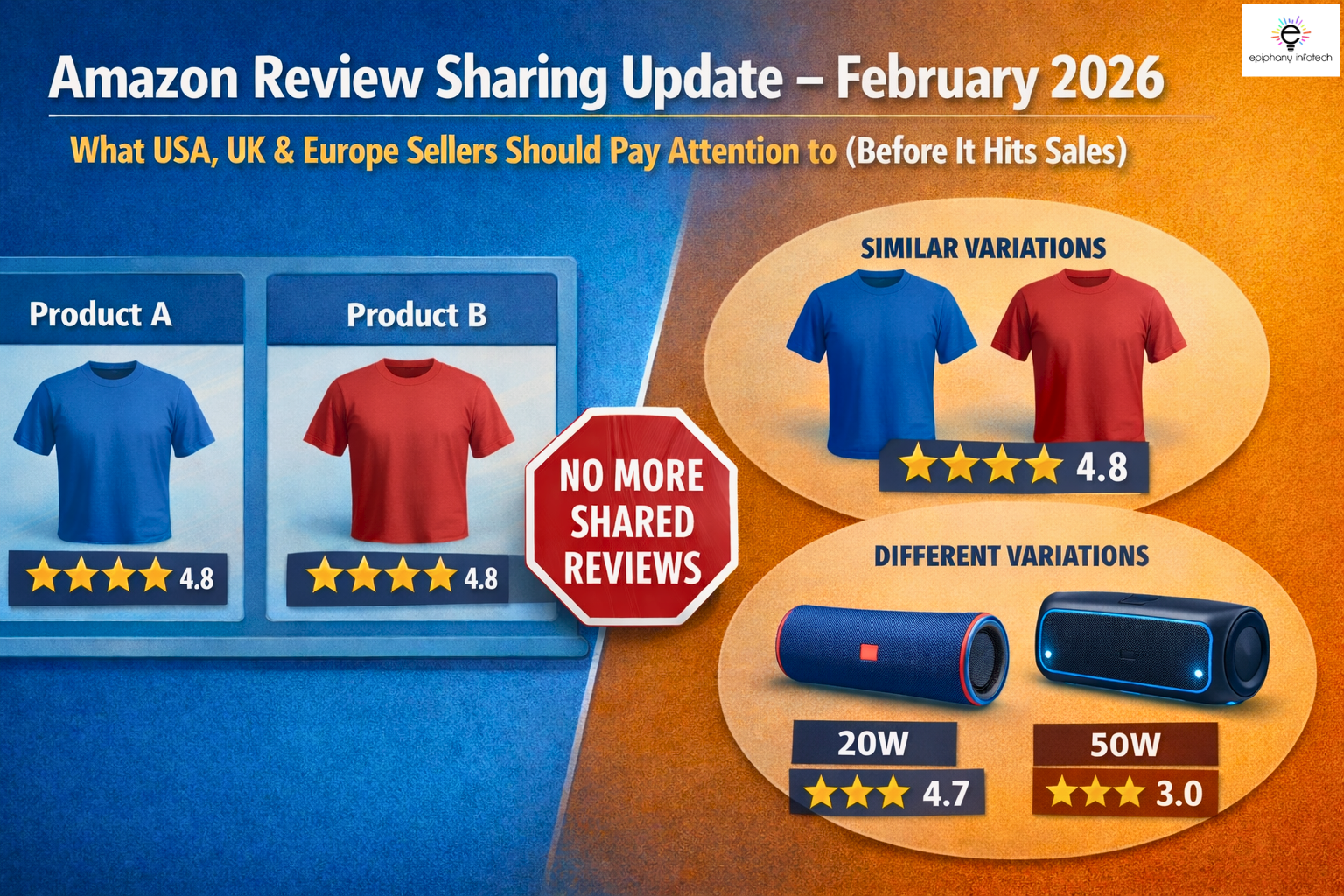
February 2026 is shaping up to be one of those moments on Amazon that looks minor on paper but quietly reshapes how listings perform in real life. If you sell on Amazon in the USA, UK, or Europe, and if reviews play any role in how your products convert (they do), this update deserves more than a quick skim.
Amazon is changing how customer reviews are shared across product variations. Not removing reviews, not banning variations, but tightening the rules around when reviews can be shared at all. For many sellers, this will change how strong or weak individual child ASINs appear overnight.
If that sounds dramatic, it is meant to. Because for some brands, this will expose listing structures that were never built to last.
What Amazon Is Really Fixing Here
For years, Amazon allowed reviews to flow freely across variations, even when those variations were meaningfully different products. Sellers benefited, customers often did not. A buyer might read glowing reviews about one version of a product, only to receive a variation with different performance, materials, or features.
Amazon has been closely watching the consequences: higher return rates, lower trust in reviews, and frustrated customers. The February 2026 update is Amazon’s attempt to correct that imbalance by ensuring that reviews accurately reflect the exact product a customer is considering, in line with Amazon seller policies and guidelines for product variations.
From now on, reviews will only be shared when variations are genuinely similar in function. If two child ASINs deliver different experiences, Amazon no longer wants one set of reviews speaking for both.
When This Takes Effect (And How Fast)
The update begins on February 12, 2026, and will roll out gradually by category through May 31, 2026. This applies across Amazon.com, Amazon.co.uk, and European marketplaces. Sellers will receive an email notice roughly thirty days before their products are affected, with all alerts and changes managed inside Seller Central, making it critical that sellers understand how Amazon Seller Central structures variations at the account level.
This is not a test or an optional programme. Once your category is updated, the change applies automatically, regardless of how long your variation has existed or how well it has performed historically.
When Reviews Will Continue to Be Shared
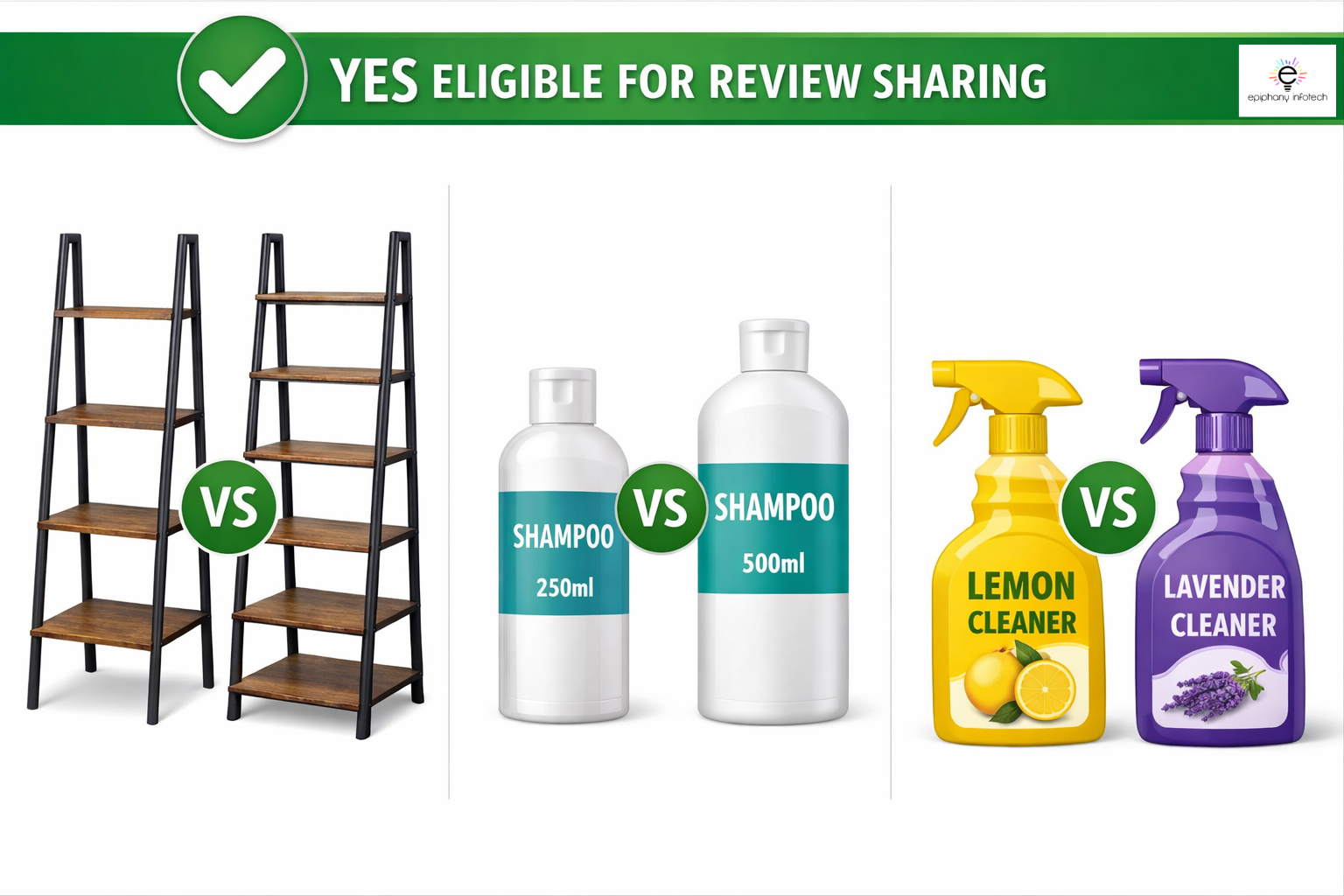
Amazon has clarified that review sharing will remain in place when variations differ only in ways that do not alter how the product functions or is used. In such cases, customer experience remains essentially the same, and shared reviews still provide accurate guidance to buyers.
Examples include visual differences such as colour or pattern, size variations that maintain the same function, different pack sizes or quantities, secondary scent variations where scent is not the main buying factor, and fitment differences for the same product designed to work with different models, such as phone cases.
For sellers whose variations fall strictly within these parameters, review sharing is unlikely to be disrupted.
When Reviews Will No Longer Be Shared
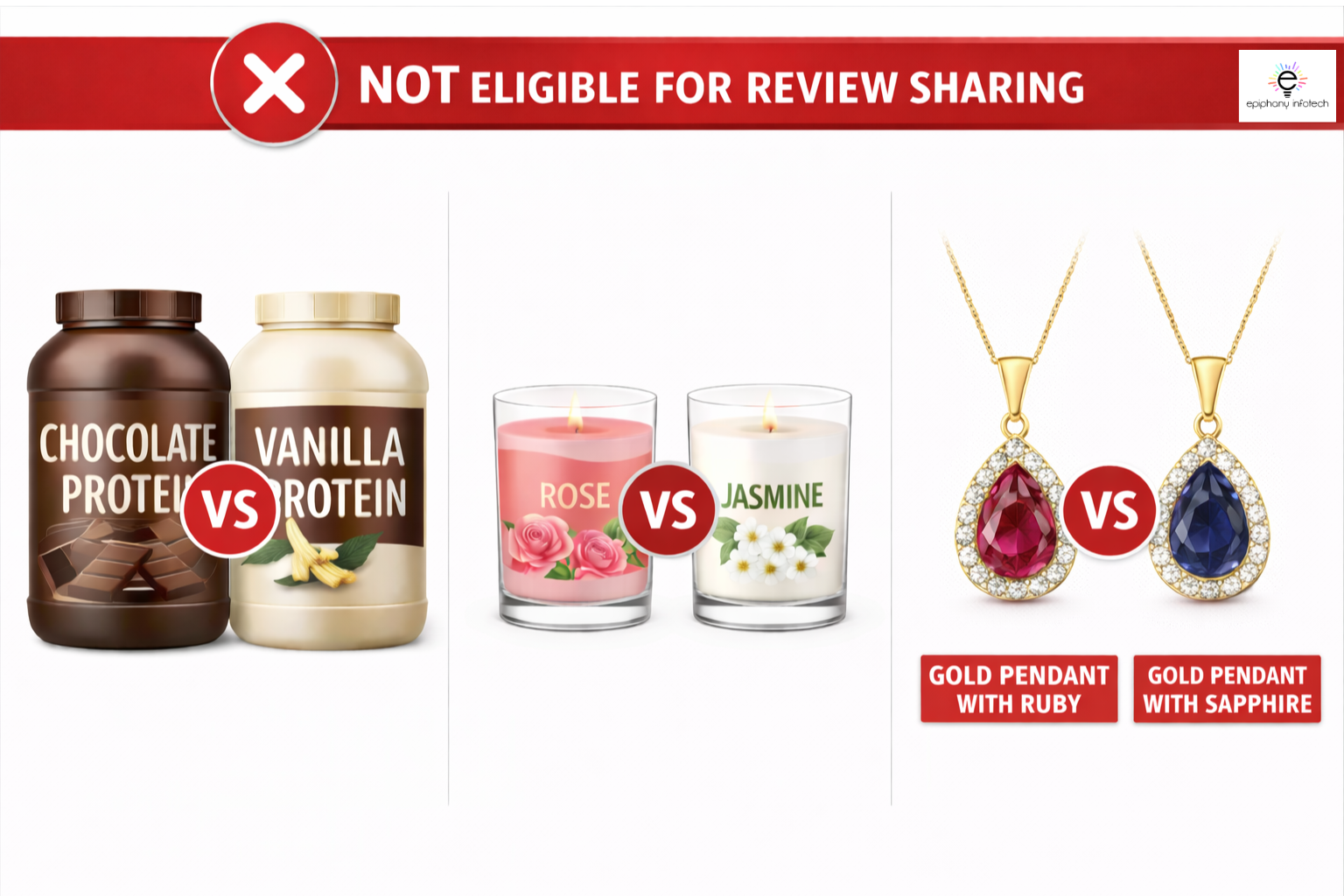
Review sharing will be removed when variations introduce meaningful differences that affect performance, usage, or customer expectations. These include changes in power, speed, memory, platform compatibility, model or generation, bundled accessories, formulation, primary scent, fit, material composition, design, or intended user group.
In practical terms, if two child ASINs do not deliver the same customer experience, Amazon will no longer allow one set of reviews to represent both. This is where many sellers may see sudden drops in review counts or star ratings at the variation level.
The Official Amazon Reference Table
To keep this information precise and verifiable, the following table is reproduced exactly as provided by Amazon.
| Products (Example comparison) | Eligible for review sharing (Y/N) | Explanation |
| Blue cotton T-shirt vs. Red cotton T-shirt | Yes | The color of the shirt is a visual difference and doesn’t change how the product is used or performs. |
| Ladder shelf (3-tier) vs. Ladder shelf (5-tier) | Yes | Both sizes serve the same function; the size change doesn’t affect performance or intended use. |
| Shampoo 250ml vs. Shampoo 500ml | Yes | The amount differs, but the formula and experience remain the same. |
| Lemon cleaning spray vs. Lavender cleaning spray | Yes | Scent is secondary and does not affect performance. |
| Phone case for iPhone 14 vs. Phone case for Samsung Galaxy S24 | Yes | Same function, different fitment. |
| Gaming laptop (16GB RAM, Intel i5) vs. Gaming laptop (32GB RAM, Intel i9) | No | Performance differences create distinct experiences. |
| Microwave 700W vs. Microwave 1200W | No | Power output affects cooking performance. |
| Bluetooth speaker (20W) vs. Bluetooth speaker (50W) | No | Wattage changes sound quality and output. |
| External HDD vs. External SSD | No | Storage technology affects speed and durability. |
| Wi-Fi 5 router vs. Wi-Fi 6 router | No | Different generations have distinct capabilities. |
| Camera body vs. Camera body + lens bundle | No | Bundles change value and usage. |
| Chocolate protein vs. Vanilla protein | No | Flavour directly affects customer experience. |
| Rose candle vs. Jasmine candle | No | Scent is the primary purchase factor. |
| Slim fit jeans vs. Regular fit jeans | No | Fit changes comfort and intended use. |
| Aluminum pan vs. Stainless steel pan | No | Material affects performance. |
| Gold pendant with ruby vs. sapphire | No | Design and perceived value differ. |
| Golf clubs for beginners vs. advanced players | No | Designed for different skill levels. |
What This Means in Real Terms for Sellers
In the short term, some listings will look weaker. Child ASINs that once benefited from a strong pool of shared reviews may suddenly show fewer reviews or lower star ratings. That can influence conversion rates, advertising efficiency, and even organic ranking at the variation level.
In the longer term, however, this change favours brands with clean listing architecture. Accurate variation structures reduce customer confusion, lower return rates, and improve buyer confidence. Amazon is effectively signalling that review manipulation through loose variation grouping is no longer acceptable.
Where Sellers Are Safe, and Where They Are Not
Amazon has been clear that review sharing is not disappearing altogether. It remains in place for variations where differences are minor and do not change how the product works. Visual differences such as colour or pattern still qualify. Size variations that maintain the same function, different pack sizes, and secondary scent differences also remain eligible. Fitment variations, such as phone cases designed for different models, continue to share reviews because the core product purpose is unchanged, reinforcing why fulfillment models and listing structure shape the customer experience on Amazon.
The problem arises when variations cross into functional territory. Differences in performance, power, material, formulation, fit, or intended user experience now trigger separation. In those cases, reviews will no longer be shared, and each child’s ASIN will stand on its own.
For sellers who have historically grouped loosely related products under one parent listing, this is where the impact will be felt most strongly.
What Sellers Should Be Doing Now
This is the moment to audit your variation families honestly. Ask whether each child ASIN truly represents the same product experience or whether differences have been bundled for convenience or ranking advantage, where variation themes are misused, correcting them before the rollout gives you more control over how reviews are redistributed by revisiting proper product listing and variation setup on Amazon.
If changes are made after the update takes effect, Amazon has confirmed that reviews can be re-shared for eligible products once variation structures are corrected. The key is not to wait until performance drops to act.
Pros & Cons of Amazon’s February 2026 Review Sharing Update
| SN | Pros for Amazon Sellers | Cons for Amazon Sellers |
| 1 | More accurate reviews per variation – Reviews will now better reflect the exact product a customer is buying, reducing misleading feedback. | Some child ASINs may lose reviews – Variations that previously benefited from shared reviews may suddenly show fewer reviews or lower ratings. |
| 2 | Improved buyer trust – Customers are less likely to feel misled, which helps long-term brand credibility, especially in competitive US and UK markets. | Short-term conversion drops possible – Variations with weaker standalone review history may convert less initially. |
| 3 | Lower return rates over time – Better-aligned expectations mean fewer “this wasn’t what I thought” returns. | Exposure of weak variation structures – Listings built by loosely grouping different products will no longer be protected by shared reviews. |
| 4 | Fairer competition – Sellers who follow correct variation rules are no longer disadvantaged by aggressive or non-compliant listings. | More work for sellers upfront – Auditing and restructuring variations requires time, effort, and sometimes professional support. |
| 5 | Cleaner listing architecture rewarded – Amazon is clearly signalling that well-structured listings will perform better long term. | Advertising performance may fluctuate – PPC campaigns tied to weaker child ASINs may see higher CPCs or lower ROAS until optimised. |
| 6 | Opportunity to optimise each variation properly – Sellers can now tailor images, bullets, and A+ content per child ASIN more strategically. | Emotional impact of “losing stars” – Even if justified, seeing ratings drop can be frustrating for sellers who relied on shared review equity. |
| 7 | Less risk of policy issues later – Aligning with Amazon’s intent now reduces the chance of future suppressions or forced restructures. | Global sellers must manage changes across regions – USA, UK, and EU listings may not all be affected at the same time, adding complexity. |
How should sellers interpret this table?
The key takeaway is this: Amazon is trading short-term seller comfort for long-term marketplace trust. Sellers who have built their listings cleanly will likely benefit with minimal disruption. Sellers who relied on aggressive variation grouping may experience short-term pain but gain clarity on how to rebuild stronger, more sustainable listings.
For serious Amazon sellers, especially in the USA and UK, this update is less about reviews and more about structural discipline. Amazon is making it clear that accurate product representation is no longer optional, it is foundational.
Final Word from Epiphany Infotech
This update is not about punishing sellers. It is about forcing clarity. Amazon is aligning reviews with reality, and sellers who already operate with disciplined, clean listing architecture will feel little disruption. Those who do not may find that February 2026 exposes weaknesses they have ignored for years.
For Amazon sellers in the USA and UK, where competition is relentless, and trust drives conversion, this change is a reminder that structure is strategy. Reviews no longer protect weak foundations.
At Epiphany Infotech, we help sellers audit, rebuild, and future-proof their variation structures so platform changes like this strengthen their brand rather than destabilise it.
On Amazon, accuracy is no longer optional. It is becoming the price of staying competitive.
References
-
- Amazon Seller Central – Changes to review sharing across product variations (January 2026)
- Amazon Seller Central Help – Guidelines for reviews shared across product variations

Experienced digital marketeer obsessed with all things SEO, Amazon, and Google PPC. I love testing, learning, and teaching what actually works. Helping businesses grow – one optimized campaign at a time.