
Negative Amazon reviews can affect customer confidence and make it harder for sellers to communicate the value of their products. However, a low rating or unfavorable opinion is not automatically grounds for removal. The key is to distinguish legitimate customer feedback from content that may violate Amazon’s policies. This guide explains how to assess negative reviews, report potential violations, document evidence, and decide whether Amazon marketing and management services could help. It also covers the difference between product reviews and seller feedback, common reporting mistakes, and practical steps to take when a review remains live.
Can Negative Amazon Reviews Be Removed?
Yes. Amazon may remove reviews that violate its content guidelines or customer review policies. However, sellers cannot request removal simply because a review is negative, seems unfair, or affects sales.
Amazon encourages customers to share honest opinions about their shopping experiences, including feedback on product quality, usability, performance, and value. However, reviews must follow the platform’s standards for acceptable customer reviews.
Before reporting a review, ask yourself three questions:
- Does the content appear to violate a specific Amazon policy?
- What facts or evidence support that concern?
- Which reporting channel is appropriate for the issue?
A clear, evidence-based report gives Amazon a specific concern to assess. Ultimately, Amazon makes the final decision, and neither sellers nor third-party service providers can guarantee removal.
Product Reviews vs. Seller Feedback: What’s the Difference?
Before reporting negative content, identify whether the customer is reviewing the product or describing the buying experience. Product reviews and seller feedback serve different purposes, so this distinction matters.
Product reviews
Product reviews help shoppers understand a product’s quality, features, usability, and performance. Customers may explain what they liked, what disappointed them, or whether the item met their expectations.
Examples include:
- “The material feels thinner than I expected.”
- “The device stopped working after two weeks.”
- “The instructions were difficult to follow.”
These comments may be unfavorable, but they can reflect genuine experiences. A seller should not report a product review solely because it gives the item a low rating.
Seller feedback
Seller feedback concerns the purchasing experience, including communication, delivery, shipping, and customer service.
Examples include:
- “The seller took several days to respond.”
- “My order arrived later than expected.”
- “The seller did not resolve my issue.”
Amazon’s guidelines distinguish product-related feedback from content focused only on seller service, ordering, returns, shipping, packaging, or shipping costs and speed.
Context matters. A review that mentions a delivery problem alongside genuine product feedback is not automatically eligible for removal. Assess the full content against the relevant policy before reporting it.
Which Amazon Reviews May Violate Amazon Policies?
Amazon’s policies identify several types of content and activity that may warrant reporting. The following examples can help you recognize potential issues, but the presence of a suspicious pattern does not prove a violation.
1. Reviews containing private information
Reviews that expose private information, such as phone numbers, email addresses, physical addresses, or order details, may violate Amazon’s guidelines.
If you encounter this type of content, record the relevant details without unnecessarily reproducing or sharing sensitive information. Then report the concern through the appropriate channel.
2. Spam and irrelevant content
Spam, repetitive text, gibberish, and content made up of distracting symbols may warrant closer examination. Amazon also restricts certain content that does not comply with the language requirements of the relevant marketplace.
An unusual writing style, a short review, or awkward phrasing is not enough on its own to establish a violation. Assess the actual content rather than relying on how it sounds.
3. Harassment, threats, or prohibited language
Amazon restricts content such as threats, harassment, hate speech, and other prohibited abusive material.
Strong criticism is not necessarily harassment. A customer can express dissatisfaction in direct language without violating the rules. Focus on the specific wording and context when assessing a report.
4. Promotional content and conflicts of interest
Amazon prohibits reviews involving certain financial or personal conflicts of interest, as well as reviews created through prohibited compensation.
For example, sellers cannot review their own products or competitors’ products. Offering money, refunds, discounts, products, or other benefits in exchange for creating, changing, or removing a review is also prohibited.
An unfavorable review that appears to benefit a competitor does not, by itself, prove misconduct. A report should be based on relevant evidence, not assumptions about the reviewer’s identity or motives.
5. Reviews focused only on seller service
A product review focused exclusively on shipping, returns, ordering, or seller service may not belong in the product-review section.
However, a review that discusses delivery alongside a genuine product complaint should not automatically be treated as removable. Assess whether the content falls within a specific category that Amazon excludes from product reviews.
6. Potentially manipulated reviews
Amazon prohibits review manipulation, including prohibited attempts to influence ratings or obtain changes to customer reviews. Its customer product review policies for sellers explain the importance of maintaining authentic customer feedback.
Similar wording, unusual timing, or a sudden increase in negative reviews may justify further investigation, but these patterns do not prove manipulation on their own. A genuine product defect or recurring customer concern could also explain similar complaints.
Document the available facts and report a suspected violation through the appropriate channel.
Which Negative Reviews Generally Should Not Be Removed?
Not every negative review violates Amazon’s policies. Customers can share honest opinions about product quality, design, value, instructions, and performance, even when those opinions are unfavorable.
|
Example review |
Initial assessment |
|
“The product feels cheap for the price.” |
A potentially legitimate opinion about value and quality. |
|
“This item did not work as expected.” |
A product-performance complaint that should be assessed on its merits. |
|
“I prefer the competitor’s version.” |
A comparison that is not automatically prohibited. |
|
“The instructions were confusing.” |
Feedback about the product experience. |
|
“I gave this one star because I dislike the design.” |
A negative opinion that does not establish a policy violation. |
A seller may believe that a customer misunderstood the listing or judged the product unfairly. That disagreement is not enough to justify a removal request.
Star-only ratings also need careful consideration. Amazon allows customers to leave ratings without written comments. The absence of a written review does not, by itself, establish a policy violation or mean that the rating will be removed.
The appropriate approach is to identify a specific policy concern supported by available information, rather than focusing on the review’s commercial impact.
How to report a potentially policy-violating review through official Amazon channels.
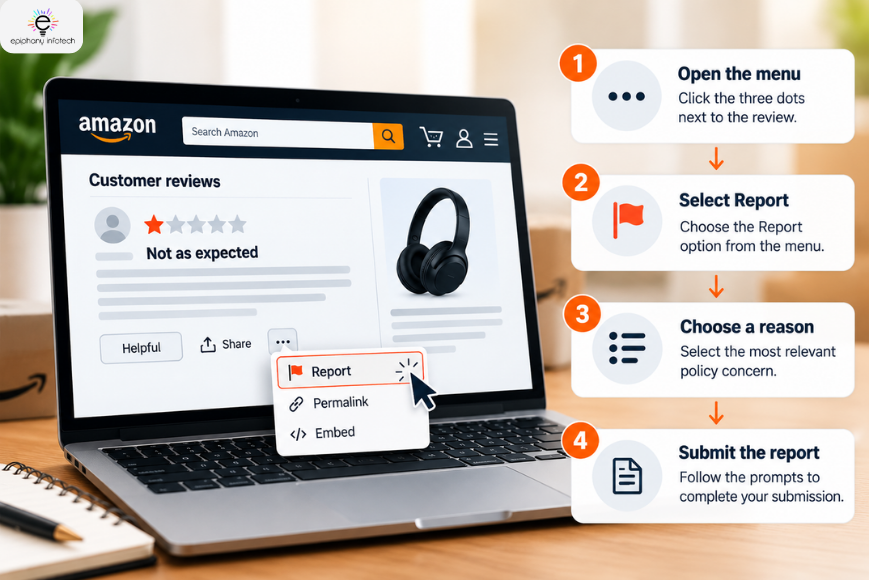
If a review appears to violate Amazon’s guidelines, start with the official reporting process. A concise, factual report helps explain the concern without relying on speculation.
Step 1: Locate the review
Open the relevant Amazon product detail page and find the review you want to report.
Confirm that you have identified the correct product, review, and marketplace. This is especially important when a listing includes multiple variations or appears across different Amazon stores.
Step 2: Select the Report option
Amazon’s US Community Guidelines describe a reporting process that includes these steps:
- Locate the review on the product detail page.
- Select Report beneath the review.
- Follow the on-screen prompts, choose the relevant reason, and submit the report.
Amazon may update its interface, so follow the instructions currently displayed on the platform.
Step 3: Identify the specific policy concern
Determine which Amazon guideline may apply. For example, the concern could involve private information, prohibited promotional content, or material focused exclusively on seller service.
Avoid submitting a general complaint that the review is unfair or damaging. Explain the specific issue and connect it to the relevant guideline where possible.
Amazon’s review-related requirements for sellers can help clarify which issues may warrant reporting and which types of negative feedback should remain.
Step 4: Prepare relevant evidence
Keep your explanation concise and factual. Describe the content that raises concern and explain why it may conflict with the applicable policy.
Avoid unsupported accusations against reviewers or competitors. Include only information that is relevant and appropriate for the reporting process.
Here is a sample report you can adapt:
I am reporting this review because it appears to contain a potential policy violation involving [specific concern]. The relevant content is [brief factual description]. I believe this may conflict with Amazon’s guidance on [applicable policy]. Please review the content under the relevant policy.
Use this template only when the concern is genuine. Replace the placeholders with accurate details, and do not claim a violation that the available information cannot support.
Step 5: Submit the report and retain the details
Follow Amazon’s instructions and retain any confirmation or case reference provided.
Submitting a report does not guarantee removal. Amazon evaluates the concern and determines whether action is warranted. If the issue involves suspected seller abuse or broader review manipulation, consult the relevant official reporting guidance to identify the appropriate route.
How to evaluate suspicious review patterns without assuming that suspicion proves misconduct.
Sometimes a seller’s concern involves several reviews rather than one isolated comment. Multiple reviews may appear close together, use similar wording, or describe issues that seem inconsistent with the product.
These patterns can justify closer examination, but they do not prove that the reviews are fake or that a competitor is responsible.
Focus on verifiable information
A responsible assessment separates observable facts from assumptions. Relevant information may include:
- The review text and publication date.
- The product and marketplace involved.
- Specific details supporting the suspected policy violation.
- Relevant communications or other legitimately obtained evidence.
- The Amazon policy that may apply.
For example, several reviews appearing around the same time may deserve further examination. However, timing alone does not establish manipulation. Similarly, repeated complaints about the same product issue could indicate a genuine quality or usability problem.
Focus on what the evidence supports, not on building a case around a preferred explanation.
Avoid unsupported accusations
Do not publicly label reviewers as fake or accuse competitors of manipulation without evidence.
A missing Amazon Verified Purchase badge is not proof of misconduct. Amazon’s US review guidance explains that eligible customers may review products purchased elsewhere, subject to the applicable eligibility criteria.
Document verifiable facts, identify the potential policy concern, and allow Amazon to assess the report.
What Happens After You Report a Review?
After you submit a report, Amazon assesses the concern and determines whether action is appropriate. The outcome depends on the content, the applicable policy, and Amazon’s assessment.
Possible outcomes include:
- The review remains: Amazon may determine that the content complies with its guidelines.
- The review is removed: Amazon may take action if it determines that the review violates its policies or another recognized removal condition applies.
- Further follow-up is needed: Depending on the reporting route, you may need to consult the relevant case or support interface.
These are possible outcomes, not a guaranteed sequence. Amazon does not publish a universal removal deadline that applies to every seller report.
What if the review remains?
Check any response or case information available through the official channel. Consider whether your original report clearly identified the concern and whether relevant information was omitted.
If an appropriate follow-up route is available, use it to clarify the existing concern. Repeatedly submitting unsupported allegations is unlikely to improve the quality of a report.
If the review reflects a genuine product or customer-service issue, address that problem as well. Improving product quality, updating instructions, clarifying the product listing, or resolving a service concern may help prevent similar complaints in the future.
DIY Reporting vs. Specialist Amazon Review-Removal Assistance
Sellers can handle many review assessments internally, particularly when the concern is straightforward and the team understands Amazon’s policies. However, managing reports across multiple products can make consistent assessment, documentation, and follow-up more demanding.
|
Consideration |
Internal reporting |
Specialist assistance |
|
Policy assessment |
Your team evaluates the concern. |
A specialist assesses the review against applicable policies. |
|
Evidence preparation |
Your team organizes relevant information. |
A specialist helps organize supporting evidence. |
|
Reporting |
Your team submits the report. |
A specialist assists with reporting under the agreed scope. |
|
Follow-up |
Your team monitors available case information. |
A specialist follows up through the applicable process. |
|
Cost |
Requires internal staff time and resources. |
Depends on the agreed service terms and outcomes. |
Specialist assistance can help structure the process, but it does not give a provider control over Amazon’s decisions or access to a guaranteed removal route.
Before hiring a service, ask how reviews are assessed, what evidence is considered, which reporting and follow-up steps are included, and how successful outcomes are defined. Be cautious of providers promising guaranteed removals, privileged access to Amazon, or the removal of every negative review.
For sellers managing reviews across multiple products, Epiphany’s Amazon marketing management support may also be relevant to broader marketplace operations.
How Epiphany Infotech’s Amazon Review Removal Service Works
Our service helps Amazon sellers assess potentially policy-violating reviews, organize supporting evidence, report appropriate cases, and follow up through the relevant channels.
The focus is on identifying genuine policy concerns, not removing legitimate customer criticism simply because it is unfavorable.
Step 1: Review assessment
We assess the review to determine whether there is a reasonable, evidence-based basis for further action under Amazon’s applicable policies.
A low rating or negative opinion alone is not sufficient. The assessment focuses on the potential policy concern and the information available to support it.
Step 2: Evidence preparation
When a review warrants further assessment, we organize the relevant information and supporting evidence.
This helps clarify the concern and connect it to the applicable Amazon policy. Reports remain focused on verifiable facts rather than unsupported allegations about reviewers or competitors.
Step 3: Reporting through official Amazon channels
Where the assessment supports reporting, we help report the potentially violating review through the appropriate official Amazon channel.
Amazon retains control over its review system and decides whether action is warranted. Our service does not claim privileged access or the ability to force a removal decision.
Step 4: Case follow-up
We follow up on reported cases as part of the agreed service, using the applicable reporting or support process.
This allows us to review available case information and identify appropriate next steps. Follow-up does not guarantee removal or a particular turnaround time.
Performance-based pricing
Our service uses a performance-based pricing model tied to Amazon removing the reported review.
Before work begins, the service agreement should clearly define the fee, billing conditions, exclusions, and how cases involving multiple reviews are handled. Sellers should understand what counts as a successful outcome and when a fee becomes payable.
Amazon remains the final decision-maker. We do not promise that every reported review will be removed, and legitimate customer criticism is not a target for removal.
Who can benefit from the service?
Our service is intended for sellers operating on Amazon.com in the United States and Amazon.co.uk in the United Kingdom who need help assessing and reporting potentially policy-violating reviews.
It may be useful for sellers who want support with policy assessment, evidence preparation, reporting, and case follow-up. The starting point is a review-specific assessment to determine whether there is a reasonable, evidence-based concern under the relevant marketplace’s policies.
Key Takeaway: Take a Policy-Based Approach to Negative Amazon Reviews
Negative reviews are a normal part of selling on Amazon, but some may warrant reporting if they violate the platform’s policies. Sellers should identify specific policy concerns, document relevant evidence, and use the appropriate reporting channels rather than trying to remove genuine customer criticism.
When a review requires closer assessment, specialist assistance can help with evidence preparation, reporting, and follow-up. If you need help managing your Amazon marketplace presence, explore www.epiphanyinfotech.com to learn more about the support available for your business. Our performance-based review removal service operates under agreed terms, with pricing tied to Amazon removing the reported review. However, removal is not guaranteed.
Frequently Asked Questions
Can I remove a negative Amazon review myself?
You can report a review if you believe it violates Amazon’s guidelines, but Amazon decides whether to remove it. Sellers cannot directly delete customer reviews. Before reporting a review, it’s important to understand Amazon’s review policies and identify whether the content violates the platform’s guidelines.
Can Amazon remove a review without written comments?
Amazon allows customers to leave star ratings without written reviews. The absence of written comments does not, by itself, establish a policy violation or mean the rating will be removed.
Can I report a review if the customer did not buy the product on Amazon?
Yes, if there is a genuine policy concern. A missing Amazon Verified Purchase badge does not automatically establish a violation. Eligible customers may review products purchased elsewhere, subject to the applicable marketplace’s criteria.
Can Amazon remove a review that compares my product with a competitor’s?
An unfavorable comparison is not automatically grounds for removal. Assess the content against Amazon’s applicable review policies rather than reporting it solely because it makes your product look bad.
How long does Amazon take to remove a reported review?
Amazon does not publish a universal removal timeline that applies to every seller report. Timing and outcomes depend on Amazon’s assessment, so avoid relying on unverified deadlines.
Can I ask a customer to change or delete a negative review?
Do not pressure a customer to change or remove a review. Amazon prohibits review manipulation, including offering compensation in exchange for creating, editing, or removing reviews. Resolve genuine customer issues without making help or compensation conditional on changing feedback.
Is seller feedback the same as a product review?
No. Product reviews concern the product itself, while seller feedback addresses the purchasing or service experience. Amazon provides different processes for these types of content.
How does your Amazon review removal service work?
Our service involves assessing potentially policy-violating reviews, preparing supporting evidence, reporting appropriate cases, and following up. Pricing is performance-based and tied to Amazon removing the reported review, subject to the agreed service terms.
Does your service guarantee that Amazon will remove a review?
No. Amazon makes the final decision. Our service focuses on assessing and reporting potential policy violations, and removal is not guaranteed for every case.
Do Amazon’s US and UK review policies work in exactly the same way?
The US and UK policies share broad principles around authentic customer feedback and review manipulation, but individual procedures and policy details may differ. Sellers should consult the official guidance for their specific marketplace.
What should I do if a negative review cannot be removed?
If a review doesn’t violate Amazon’s policies, focus on improving the product listing, addressing customer concerns, and setting clear expectations. Optimising your Amazon product listing can help ensure that product details accurately reflect what customers receive.

Experienced digital marketeer obsessed with all things SEO, Amazon, and Google PPC. I love testing, learning, and teaching what actually works. Helping businesses grow – one optimized campaign at a time.